


- BBC NEWS 3 August 2016
- China
Thursday, August 11, 2016
Wednesday, August 10, 2016
Monday, August 8, 2016
Thursday, August 4, 2016
China's elevated bus: Futuristic 'straddling bus' hits the road
 AP
AP
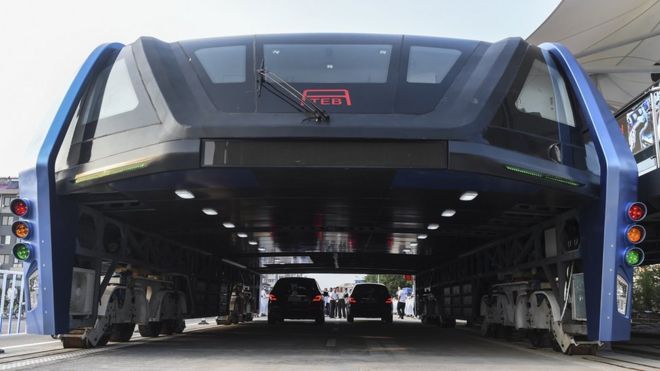
It may look like something from the future, but China's long-awaited "straddling bus" ran its inaugural test in Hebei province this week.
The 2m-high Transit Elevated Bus (TEB) straddles the cars below, allowing them to pass through.
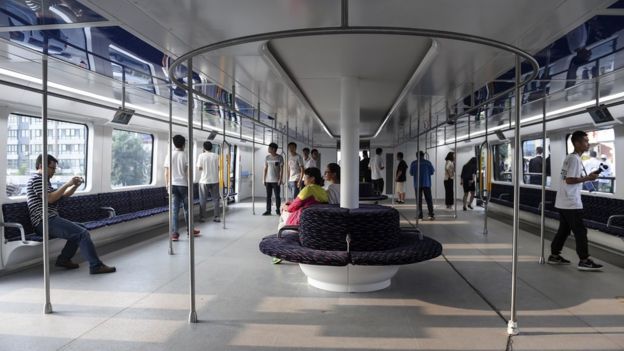
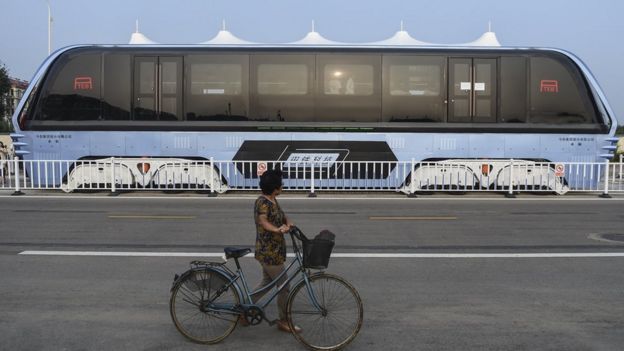
Powered by electricity, the bus is able to carry up to 300 passengers in its 72ft (21m) long and 25ft wide body.
A video of a mini-model of the vehicle caused great excitement when it was released in May.
 AP
AP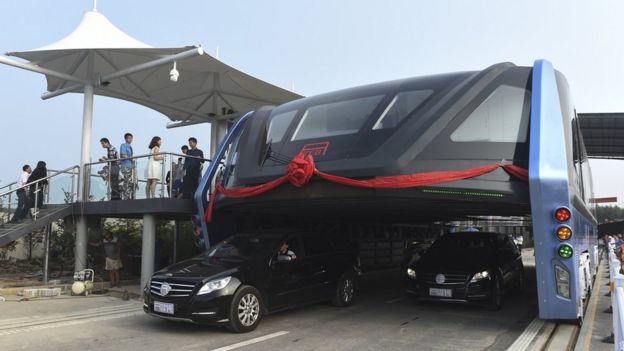 AP
AP
The trial run was conducted on a 300m-long controlled track in the north-eastern city of Qinhuangdao.
The vehicle is expected to reach speeds of up to 60km per hour, running on rails laid along ordinary roads. Up to four TEBs can be linked together.
"The biggest advantage is that the bus will save lots of road space," the project's chief engineer, Song Youzhou, told state-media agency Xinhua earlier this year.
"The TEB has the same functions as the subway, while its cost of construction is less than one fifth of the subway," another engineer Bai Zhiming told news outlet CCTV.
One TEB could replace 40 conventional buses, according to the firm. However, it is unclear when the vehicle will be widely used in Chinese cities.
 AP
AP
It is not a new idea, but it was not seriously considered until a mini-model of it was launched at the 19th China Beijing International High-Tech Expo in May.
A month later, developers announced that the TEB would be ready for a test-run in August.
Thousands took to micro-blogging site Weibo to express their amazement and incredulity.
"I saw images of this not long ago and now it's actually happening?" asked one user. "This is truly build at 'Chinese speed'".
"I swear I just saw ideas of this in pictures. Now it's appeared in real life," said another.
Friday, July 29, 2016
Technology Behind Hugely Popular Pokémon Go Game Could Be Transformative for Buildings and CRE
Forget About Squirtle, Pokémon Go Opens up New Operational, Marketing Efficiencies for Real Estate
July 27, 2016
 |
“Pokémon Go, a game that has millions of people roaming around the physical world to capture virtual characters, has taken augmented reality (AR) from a niche technology to mainstream, while highlighting a potentially lucrative new marketing platform,” Kartik Hosanagar, a professor of operations, information and decisions at The Wharton School of the University of Pennsylvania. “It’s one of the first games to merge the digital and physical world.”
AR technology appears to offer the real estate industry the potential for pioneering immersive experieinces on two fronts: the most obvious being its potential for marketing under construction property but also play a major role in bringing operational efficiencies to facility management.
On the simplest level, multifamily landlords and housing real estate agents are already tying the game into their property listings touting their proximity to ‘PokéStops,’ where players collect ‘things.’
Already, real estate agents and brokers are including how many PokéStops or Pokémon Go gyms are within walking distance of their listing as a feature; while some agents are using Pokémon characters in their ads, noted Kent Redding, principal of Kent Redding Group, a Realtor of luxury properties in Austin.
“Love it or hate it, Pokémon Go is a great way for realtors to connect with buyers,” said Redding.
But while just having a Pokéstop or gym as bait is unlikely to bring any additional value to a property sale or lease, the AR technology behind Pokémon Go is expected to have significant applicability to real estate, according to real estate brokerage firms such as HFF and CBRE.
Retailers may use it to generate an increase in foot traffic, brokers may benefit from the emerging technology to visualize real estate virtually on their smartphones, and the industrial market may use the technology to improve supply chain efficiencies.
"The whole point of augmented reality is that the consumer is physically in the reality but, through the use of technology, they are able to distort that reality in order to better visualize a wider array of options,” said Andrew L. Benioff, founder and managing partner of Llenrock Group, a real estate advisory and investment-banking firm.
Benioff sees numerous uses for his firm of the technology:
Such applications may not be that far away.
Venture capitalists have poured $1.1 billion into AR firms so far this year, according Woodside Capital Partners, a global independent investment bank in the technology sector. Together, virtual and augmented reality are estimated to become an $80 billion market by 2025.
Retailers have already begun putting the technology to use. For example, beauty suppliers such as Ulta and Sephora-offer virtual live makeup tutorials for their customers. The experience is interactive and uses multiple senses (touch, smell, feel, and sight) -- something online-only retailers can’t offer, Benioff added.
"Clearly it is too soon to tell how much Poké-metrics will impact actual retailer and restaurant foot traffic and spending, but in the age of experiential retail, this will go down as the first huge success of gamification applications as a retail tool,” said Garrick-Brown, vice president of retail research for the Americas for Cushman & Wakefield. “And that is the big story.”
“What Pokémon’s success tells us is that the idea of a workable, interactive game on smartphone devices to lure people to stores, restaurants and bars is not just a feasible one, but one with a lot of potential upside,” Brown said.
Just as there is a lot of potential upside, there is a potential downside as well for the retail industry, cautioned Llenrock’s Benioff.
There is an immediate danger from the inverse use of the application where the app can scan a consumer’s home, allowing them to virtually display a product (i.e. furniture) via hologram or graphic in their home, Benioff said.
In that case, “they may be less likely to visit a brick and mortar store,” he said.
Augment reality technology also offers potential applications well beyond the retail industry.
“A huge plus to AR in the industrial space is the fact that it cuts the time of any job, whether in the sectors of design, robotics, manufacturing or logistics,” Benioff said. “This technology can be used for transportation, administrative purposes, or even to control environmental factors and operations.”
Such uses could conceivably increase demand for industrial properties with strong and consistent power sources. Many developers turn to older, abandoned industrial spaces that may not necessarily be able to sustain the power needed for various aspects of AR, Benioff said, but new construction is usually cheaper than rehabbing a property, so investors and developers may be more keen on constructing new industrial sites which are designed to sustain high power usage and relieve network performance issues.
The overwhelming adoption of the game has also spurred interest in new data centers due to concerns surrounding 'server overload.'
The data center community may have found the catalyst that will propel gaming into becoming a critical market for data center operators, as one analyst said.
“Though it may be just a game, it’s a brief insight into the technology our world will wield 10 or even five years from now,” wrote Jack Karsten and Darrell West, analysts with The Brookings Institution. “Augmented reality of the future means instead of seeing a Charizard in front of your apartment building, a fireman can see the structural vulnerabilities, temperatures, and exit routes.”
“When the world relies on AR, [the internet of things], and 5G networks for more than a game, there are serious implications if there is latency or networks go offline completely,” they wrote. “It’s one thing when Pokémon Go freezes in the midst of catching another Weedle, but it’s another issue entirely when computers freeze or even lag in a world where robots perform surgery.”

Subscribe to:
Posts (Atom)